Among the generation of artists who shaped the language of post-Independence Indian modernism, few moved as fluidly between folk culture, performance, craft and modernist experimentation as Shiavax Chavda. While many of his contemporaries sought inspiration in monumentality or nationalism, Chavda turned repeatedly toward the rhythms of lived culture, village artisans, dancers, ritual, gesture and movement.
The works from the collection of Robert Skelton coming to auction at Olympia Auctions offer an especially revealing insight into this aspect of his practice, illuminating an artist deeply invested in transforming ordinary acts of making and performance into subjects of profound poetic and modernist significance.
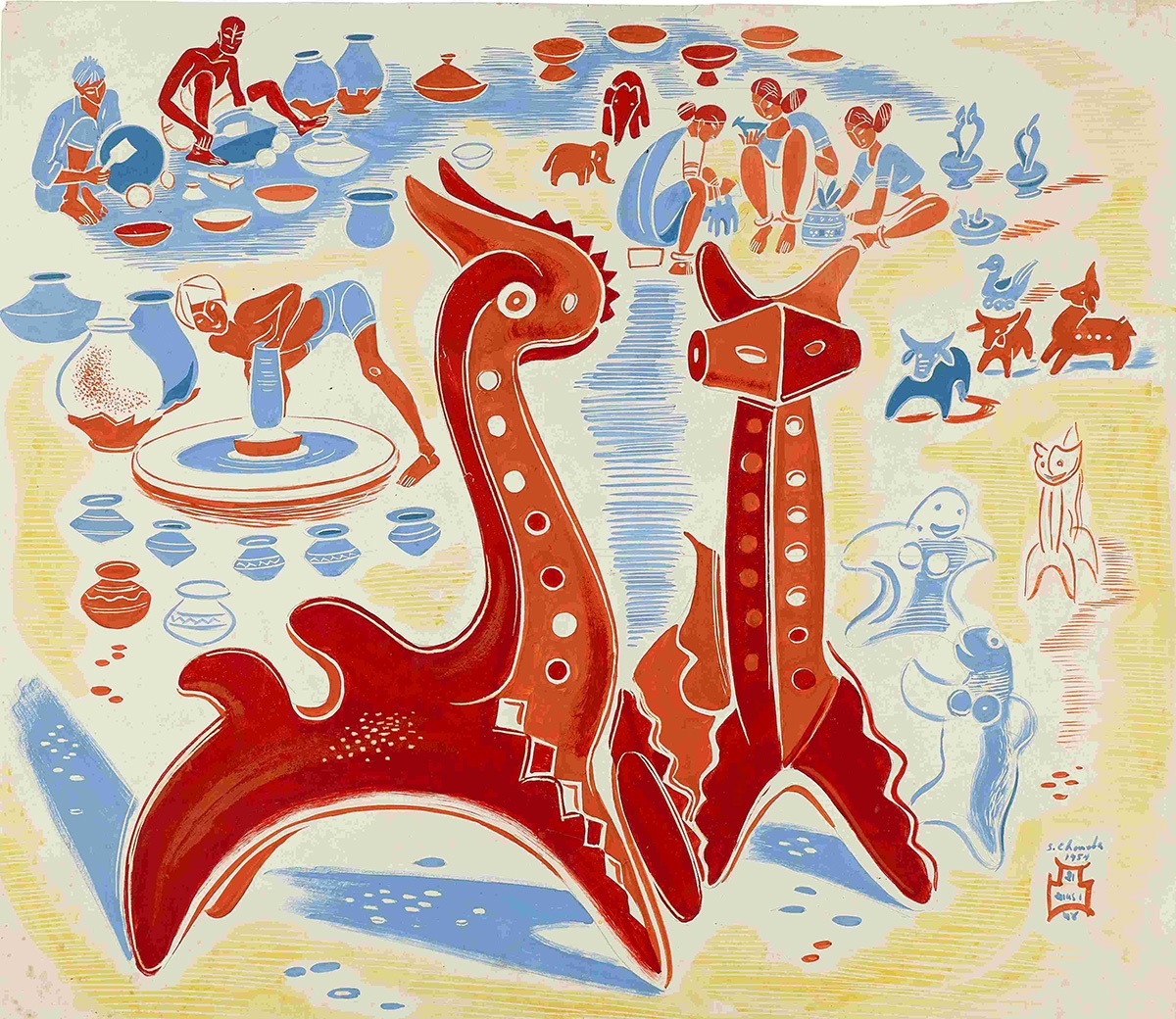
At first glance, Chavda’s painting of potters at work appears to depict a familiar artisanal scene: figures gathered within a workshop, engaged in the production of clay objects. Yet the true subject of the work gradually reveals itself to be something altogether more imaginative. Rather than focusing on the labour of pottery-making itself, Chavda redirects the viewer’s attention toward the whimsical terracotta toys and sculptural clay forms that populate the composition. The workshop becomes less a documentary study of craftsmanship and more a theatre of invention.
Most striking are the monumental horses that dominate the pictorial field. Their exaggerated forms transform humble folk toys into something almost mythical, echoing both the sculptural traditions of rural India and the formal concerns of international modernism. Chavda elevates these objects far beyond ethnographic curiosity. The terracotta horses possess a commanding physicality, their simplified volumes and rhythmic contours recalling the modernist fascination with primitivism and sculptural abstraction, while remaining deeply rooted in indigenous craft traditions.
This tension between sophistication and simplicity lies at the heart of Chavda’s importance within Indian modernism. Like several artists of his generation, he sought a distinctly Indian visual language that could engage modernist concerns without merely imitating European precedents. Yet Chavda’s approach was uniquely lyrical. Rather than monumentalising history or mythology, he discovered artistic profundity within the everyday creativity of artisans and performers. Folk culture, in his hands, became not an object of nostalgia but a living aesthetic vocabulary.
The painting’s compositional structure further reinforces this sense of play and transformation. Space appears compressed and animated, with figures, toys and forms existing in a dynamic relationship rather than within strict perspectival order. The pottery workshop becomes almost dreamlike, suspended somewhere between observation and imagination. Chavda was less concerned with realism than with emotional and rhythmic resonance. His brushwork and handling of form infuse the scene with vitality, suggesting movement even within ostensibly static objects.
This fascination with rhythm and movement emerges even more powerfully in the accompanying dancer study included in the sale. Produced during the mid-1950s, this work belongs to a wider body of studies through which Chavda became increasingly absorbed in the expressive possibilities of the human body. Dance occupied a profoundly important place in his artistic imagination, not merely as spectacle or performance, but as a visual embodiment of rhythm, emotion and spiritual intensity.
This particularly beautiful study, rendered in rich sepia and brown tones, demonstrates Chavda at his most sensitive and lyrical. The dancer appears almost suspended in motion, simultaneously sculptural and ephemeral. There is an extraordinary fluidity to the composition: contours dissolve and reform, lines curve with musical cadence, and the body seems to hover between physical presence and abstraction. Chavda’s handling of line creates a remarkable sense of three-dimensionality while retaining the spontaneity and immediacy of a sketch.
The work possesses an almost trance-like quality, as though the dancer is dissolving into movement itself. Here, Chavda transcends portraiture. The figure is not presented as an identifiable individual, but rather as an embodiment of rhythm and grace. Across many of his dancer studies, movement becomes the true subject matter. Gesture, repetition and bodily energy are distilled into flowing forms that border on the musical.
This preoccupation with dance aligned Chavda with broader cultural currents emerging in post-Independence India, when artists, performers and intellectuals were re-engaging with classical and folk traditions in order to articulate new forms of cultural modernity. Yet Chavda’s treatment remained deeply personal. His dancers are neither ethnographic records nor idealised nationalist symbols. Instead, they exist within a highly individual visual language shaped by spontaneity, intuition and emotional sensitivity.
The significance of this wider series is underscored by the fact that three related examples were gifted by the artist to the Victoria and Albert Museum in 1955. It was likely around this same period that Robert Skelton, then at the beginning of his distinguished engagement with Indian art, first became closely acquainted with Chavda and his practice. Skelton would later become one of the foremost authorities, curator of Indian painting and sculpture, and the presence of these works within his collection suggests not only scholarly admiration but potentially a direct personal connection with the artist himself.
Seen together, the potters and the dancer reveal two complementary dimensions of Chavda’s artistic vision. In one, he celebrates the imaginative vitality embedded within artisanal craft traditions; in the other, he explores the expressive and almost spiritual possibilities of bodily movement. Both bodies of work are united by a profound sensitivity to rhythm, transformation and play. Chavda consistently sought moments where ordinary experience could become poetic, where labour could become theatre, and where gesture could become abstraction.
These works also illuminate a broader moment within Indian modernism itself: a period in which artists were redefining the relationship between modern art and indigenous culture. Rather than rejecting tradition in pursuit of internationalism, Chavda demonstrated how local craft practices, folk aesthetics and performative traditions could themselves become vehicles for modernist experimentation. His work occupies a compelling space between intimacy and monumentality, observation and imagination, tradition and reinvention.
Today, these paintings remain deeply resonant not only for their aesthetic beauty, but also for the generosity of vision they embody. Chavda approached dancers, artisans and makers not as peripheral subjects, but as central participants in the cultural life of modern India. In doing so, he expanded the possibilities of what Indian modernist painting could encompass.
These works can be viewed alongside the wider catalogue online and at Olympia Auctions ahead of the sale on 20th May.
The diverse catalogue offers a fascinating cross-section of artistic traditions, personal histories and cultural exchanges spanning centuries.